
Wood
The lowest-cost option and a natural match for a wood deck. Needs periodic cleaning and re-staining; the USDA Forest Products Laboratory recommends penetrating, pigmented finishes because pigment blocks UV.
Get free quotes from independent local contractors to replace wobbly railings, add new deck stairs or upgrade to aluminum, composite or glass.
Get a Free Quote Call (727) 300-6656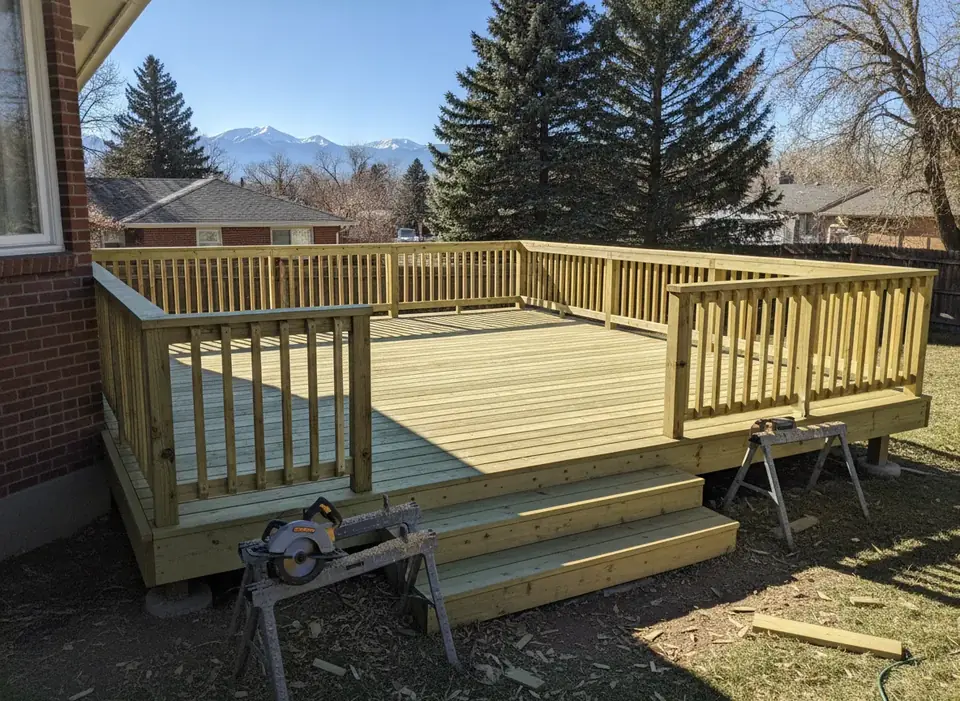
Railings (guards, in code language) and stairs are the parts of a deck people lean on, grab and climb every day. They are also among the first parts to loosen as wood dries, shrinks and goes through Denver’s freeze-thaw cycles; NOAA normals for Denver International Airport show about 156 nights a year at or below 32 °F. A railing that moves when you push on it, or stairs that bounce or tilt, are signs to have the deck looked at.
The North American Deck and Railing Association (NADRA) marks May as Deck Safety Month and encourages homeowners to “Check Your Deck” each year.
We connect Denver-area homeowners with independent local deck builders for free, no-obligation quotes. The contractor you choose quotes, permits, contracts and builds directly with you.
Denver adopted the 2025 Denver Building Code, which amends the 2024 IRC and IBC. Under it, guards must be at least 36 inches tall where required. The model code allows 34 inches along the sides of stairs, measured from the line of the stair nosings. Guards are generally required where the walking surface is more than 30 inches above the ground: Lakewood’s deck handout requires railings over 30 inches, and the Douglas County checklist says a guardrail is not required on a deck less than 30 inches above grade.
Denver deck plans must show stairs, guards and handrails along with footing size and depth, ledger and uplift connections. Most decks over 12 inches off the ground need a zoning permit; decks 30 inches or more above grade, decks over 200 sq ft, and all covered decks, porches and pergolas also need a building permit. Rules change; confirm with Denver Community Planning and Development. This is general information, not legal advice.
Strong railings need a strong deck behind them. If the posts are loose because the framing or ledger is failing, read deck ledger attachment safety and consider deck repair first.
The lowest-cost option and a natural match for a wood deck. Needs periodic cleaning and re-staining; the USDA Forest Products Laboratory recommends penetrating, pigmented finishes because pigment blocks UV.
Pairs with composite and PVC decks. Costs more than wood but needs no staining, only cleaning.
Slim powder-coated balusters or cable-style panels that keep views open. A wide price range depending on the system.
The most open view of the mountains or yard, and the highest cost. Panels need regular cleaning.
Denver sits at about 5,280 feet, and UV exposure rises with elevation (EPA), so any wood or painted railing will need more upkeep than one that is never refinished. Colorado also sits in “hail alley” (NSSL: about 7–9 hail days a year there); ask contractors how each material handles hail.
| Item | Typical range (installed) |
|---|---|
| Wood railing | $20–$50 per linear ft |
| Vinyl or composite railing | $25–$60 per linear ft |
| Aluminum railing | $50–$200 per linear ft |
| Glass railing | $100–$600 per linear ft |
| Example: 40 linear ft | about $800–$2,000 wood; $1,000–$2,400 vinyl/composite; $2,000–$8,000 aluminum |
| Deck stairs | $1,400–$2,600 |
| Deck repair in Denver | average about $1,891 (typically $746–$3,060) |
Typical ranges from published cost guides (2025–2026) — estimates, not quotes. The example row is arithmetic on the guide range. Height, number of corners and posts, stair layout and whether old railings must be removed all change the price. Add railings and stairs to a full estimate with the Denver deck cost calculator.
Stairs need their own landing or footing at the bottom, stringers sized for the run, and handrails and guards where the code requires them. In Denver, footings go below the 36-inch frost line to resist heaving, and the 2025 Denver Building Code requires decks to carry the greater of the live load or the 43 psf ground snow load. A contractor lays out the rise and run to fit your deck height and yard, and the details go on the permit plans.
Snow and ice make stairs the slipperiest part of a deck in winter. The National Weather Service lists about 47 inches of snow a year in Denver, so think about where shoveled snow will go and whether the stairs face north and stay shaded.
Describe the railing length, material and any stairs. Independent contractors visit and quote in writing.
Posts and stringers are only as strong as the framing they attach to, so a good quote looks at that too.
Where a permit applies, the contractor you hire pulls it and schedules inspections.
Replacing most of the deck anyway? See deck replacement in Denver.
Under the 2025 Denver Building Code, which amends the 2024 IRC, guards must be at least 36 inches tall above the walking surface where they are required. The model code allows 34 inches on stair sides, measured from the line of the stair nosings. Your contractor and the building department confirm the details on your plans. This is general information, not legal advice.
Guards are generally required where a deck surface is more than 30 inches above the ground. Lakewood’s deck handout requires railings above 30 inches, and the Douglas County checklist says a guardrail is not required on a deck less than 30 inches above grade. Denver plans must show guards, stairs and handrails. Confirm with your city or county.
Published cost guides (2025–2026) show installed railing at about $20–$50 per linear foot for wood, $25–$60 for vinyl or composite, $50–$200 for aluminum and $100–$600 for glass. A 40-foot run would be roughly $800–$2,000 in wood or $2,000–$8,000 in aluminum. These are estimates, not quotes.
Published cost guides (2025–2026) put installed deck stairs at about $1,400–$2,600. The number of steps, the material, landings, handrails and footing work all affect the price. Stairs on a high deck cost more than a short run of two or three steps. These are estimates, not quotes; your contractor prices your project.
It depends on the scope. Denver requires deck plans to show stairs, guards and handrails, and decks 30 inches or more above grade need a building permit. Replacing railings as part of a larger rebuild is usually covered by the deck permit. Ask Denver Community Planning and Development before work starts. This is general information, not legal advice.
Free, no-pressure quotes across Denver, Aurora, Lakewood, Littleton, Highlands Ranch and Arvada.