
Deck Staining & Sealing in Denver, CO
Get free quotes from independent local contractors to clean, stain and seal a wood deck before Denver’s sun and winters wear it down.
Get a Free Quote Call (727) 300-6656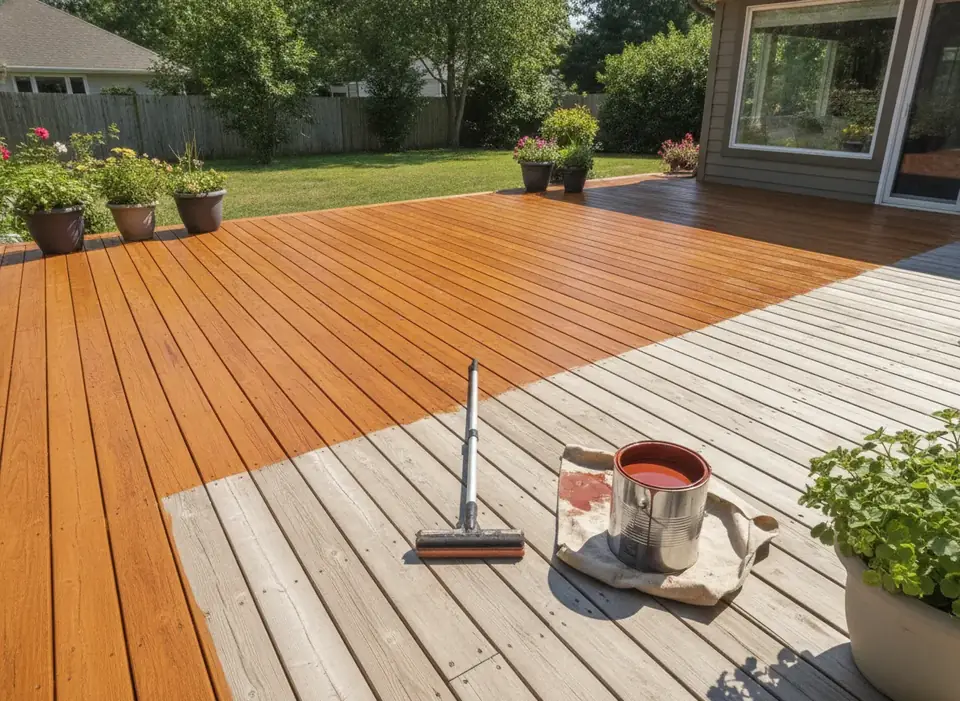
Why Denver decks need a regular finish
A wood deck in Denver takes a lot of punishment. NOAA’s 1991–2020 normals for Denver International Airport show about 156 nights a year at or below freezing, a July average high near 90 °F and 46 days a year at 90 °F or more. The National Weather Service lists about 47 inches of snow a year, and hail storms are common across the Front Range. Worn wood soaks up moisture, then cracks in the sun.
The city also sits at about 5,280 feet, and UV exposure rises with elevation (EPA). The USDA Forest Products Laboratory (FPL) names UV radiation, water and abrasion as the main causes of wood weathering. A good stain and sealer slows all three. Searches for “deck staining Denver” jump every March as homeowners plan spring projects.
We connect Denver-area homeowners with independent local deck builders for free, no-obligation quotes. The contractor you choose quotes, permits, contracts and builds directly with you.
Penetrating finishes: what the research recommends
The Forest Products Laboratory, the federal wood research lab, recommends penetrating finishes for decks over film-forming finishes. That group includes water-repellent preservatives, pigmented water repellents and semitransparent stains. They soak into the wood instead of building a skin on top, so they wear away gradually rather than peeling or flaking under foot traffic and snow shovels.
Pigment is the key to sun protection: the FPL notes that pigment blocks UV, which is what turns unprotected wood gray. Clear water repellents keep out moisture but give little UV protection, so they need re-coating more often. Solid-color stains and paints form a film instead.
How long does deck stain last?
A trade source (the Journal of Light Construction) puts semitransparent stain at about 2–3 years on horizontal deck surfaces. Railings, posts and fascia get less wear and often last longer. A simple test: sprinkle water on the boards. If it soaks in quickly instead of beading, the finish is due.
Composite decks
Composite and PVC decks are not stained like wood. If you are tired of re-staining, see composite and PVC decks in Denver for the trade-offs; composite costs more up front, while wood needs periodic cleaning and re-staining.
What a staining and sealing job usually includes
Inspect
The contractor checks for loose boards, popped fasteners, soft spots and wobbly railings. Rot or structural problems should be fixed before any finish goes on; see deck repair.
Clean or strip
Boards are washed with a deck cleaner. If an old film or solid stain is failing, it may need stripping, which raises the cost.
Dry and prep
The FPL says finish should go on clean, dry wood in suitable weather. Light sanding may smooth raised grain.
Apply the finish
A penetrating stain or water-repellent preservative is applied to decking, stairs and railings, with attention to board ends.
Timing matters. The median last spring freeze in Denver is May 5 and the median first fall freeze is October 9 (NOAA), which gives roughly a 156-day freeze-free season. Most homeowners plan staining between late spring and early fall, and booking a quote in March or April helps you get on a contractor’s calendar.
Deck staining cost per square foot in Denver
| Item | Typical range |
|---|---|
| Wash, stain and seal | $1.57–$4.04 per sq ft |
| Stripping and refinishing | $3.00–$6.50 per sq ft |
| Example: 300 sq ft re-coat | about $470–$1,210 |
| Deck repair in Denver (if needed first) | average about $1,891 (typically $746–$3,060) |
Typical ranges from published cost guides (2025–2026) — estimates, not quotes. The example row is simple arithmetic on the guide range. Price depends on deck size, how many railings and stairs there are, the condition of the old finish and the product chosen. For a full estimate including repair or replacement, use the Denver deck cost calculator.
Is it time to replace instead? If boards are splitting, framing is soft or the deck predates modern ledger practice, staining only hides the problem. The median home in Denver was built in 1975 (ACS 2024 5-year estimates), so many older decks may be due for deck replacement.
Before you hire a contractor
- In Denver, confirm the contractor holds a current City and County of Denver contractor license (residential work is normally Class C) and will pull the permit. In Aurora, Lakewood, Littleton, Arvada, Thornton, Douglas County (Highlands Ranch) and other suburbs, confirm the contractor is licensed or registered with that city or county.
- Ask for proof of liability and workers’ compensation insurance.
- Get a written contract with the scope, materials and payment schedule.
- Get HOA approval, and in Denver historic districts a Certificate of Appropriateness, before work starts.
Staining alone normally does not need a permit, but any repairs or rebuilding done at the same time may. In Denver, most decks over 12 inches off the ground need a zoning permit, and decks 30 inches or more above grade, decks over 200 sq ft, and all covered decks, porches and pergolas also need a building permit. Rules change; confirm with Denver Community Planning and Development. This is general information, not legal advice.
For more on finishes in strong sun, read deck staining in the Colorado sun.
Deck staining quotes across the Denver metro
Request a quote for Denver or nearby suburbs, including:
Deck staining FAQ
How often should a deck be stained in Denver?
A trade source (JLC) puts semitransparent stains at about 2–3 years on horizontal deck surfaces, and vertical parts such as railings usually last longer. Denver’s strong sun and freeze-thaw winters wear finishes, so many homeowners check the boards each spring. When water stops beading and the color looks faded or gray, it is time to clean and re-coat.
How much does deck staining cost in Denver?
Published cost guides (2025–2026) show about $1.57–$4.04 per sq ft for washing, staining and sealing, and $3.00–$6.50 per sq ft when the old finish has to be stripped first. A 300 sq ft deck would land around $470–$1,210 for a standard re-coat. These are estimates, not quotes; your contractor prices your actual deck.
Is a penetrating stain better than deck paint?
The USDA Forest Products Laboratory recommends penetrating finishes, such as water-repellent preservatives and semitransparent stains, for decks over film-forming finishes like paint or solid-color coatings. Penetrating finishes soak into the wood rather than forming a surface film, so foot traffic and weather wear them gradually instead of making them peel. Pigment in the stain helps block UV.
When should I stain my deck in Denver?
The Forest Products Laboratory says to apply finish to clean, dry wood in suitable weather. In Denver the median last spring freeze is May 5 and the first fall freeze is October 9 (NOAA normals), so late spring through early fall is the usual window. Search interest peaks in March, so booking a quote early helps.
Does the high altitude in Denver affect deck stain?
The EPA says UV exposure rises with elevation, and Denver sits at about 5,280 feet. UV is one of the main causes of wood weathering, which is why the Forest Products Laboratory points to pigmented finishes that block UV. No reliable source gives an altitude-specific lifespan for stain, so plan on checking the finish every year.
Plan your deck before the spring building rush.
Free, no-pressure quotes across Denver, Aurora, Lakewood, Littleton, Highlands Ranch and Arvada.