
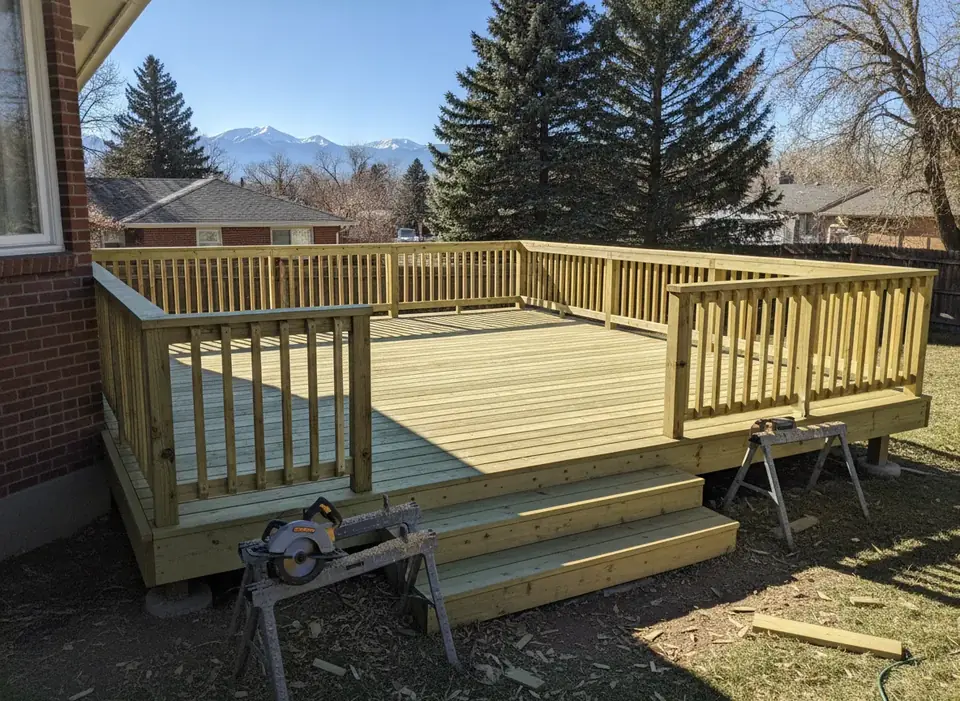
In the Denver area, most deck building happens between spring and fall, roughly from the median last freeze around May 5 to the median first freeze around October 9 (NOAA 1991–2020 normals, Denver International Airport). But the planning should start months before: getting quotes, HOA approval and a permit takes time, so homeowners who want a deck by early summer usually start in late winter. Footings must reach Denver's 36-inch frost line, and Front Range weather swings, so framing can continue on dry days in the shoulder seasons, while concrete and staining are easier in the warmer months.
Denver's building calendar by the numbers
NOAA's 1991–2020 climate normals for Denver International Airport (NOAA annual normals; monthly normals) give a useful frame:
| Measure | Denver (DIA normal) | What it means for a deck |
|---|---|---|
| Median last spring freeze | May 5 | Cold nights linger into spring |
| Median first fall freeze | October 9 | Fall work can go into early October |
| Freeze-free season | About 156 days | The warm window is about five months |
| Nights at or below 32 °F | About 156 a year | Winter and shoulder seasons are cold at night |
| Wettest months | May (2.16 in.), July (2.14 in.) | Afternoon storms can stall work |
| Days at 90 °F or above | About 46 a year | Hot afternoons in July and August |
Snow adds to the picture: NWS Boulder lists about 47 inches a year (NWS). Medians are not promises. Half of years see a freeze after May 5, and spring snow is common.
Footings and the 36-inch frost line
The 2025 Denver Building Code sets the frost line at 36 inches below finished grade (2025 Denver Building Code), so footings for a permitted deck go at least that deep unless the deck is exempt. Digging and pouring concrete are the steps most affected by cold, wet or frozen ground, and that is a main reason footings often get scheduled once spring has settled. Denver plans must show footing size and depth (Denver CPD).
Once footings are in, framing and decking are less weather-bound. Contractors often keep framing on dry days into late fall, but each builder sets its own cold-weather practices, so ask.
Why March and September matter
Search data shows two clear peaks for "deck builders Denver": March and September, with lows in November and December. Those months are when people start planning, not necessarily when crews break ground.
- March planning, summer deck. If you start getting quotes in March, the time needed for drawings, HOA review and a permit can carry you to a late spring or early summer build. Start later and your project may land after the busiest weeks.
- September planning, two paths. A simple deck may still fit before the first freeze. A larger or covered project may be better to design and permit over the winter for an early spring start.
- Winter planning. Slow months are a reasonable time to compare quotes and get approvals lined up.
Permit lead time: plan for it
Permit timing varies by city, by how complete the plans are and by how busy the department is, so there is no single number to plan around. What is predictable is the sequence. In Denver, most decks over 12 inches off the ground need a zoning permit; decks 30 inches or more above grade, decks over 200 sq ft, and all covered decks, porches and pergolas also need a building permit. Rules change; confirm with Denver Community Planning and Development. Covered decks and pergolas always need both, and homes in historic districts add a Certificate of Appropriateness review.
In most of the metro, an attached deck or any deck 30 inches or more above grade needs a permit; Denver adds a zoning permit above 12 inches, and Parker requires a permit for every deck. Building first is expensive: in Denver, fees double (minimum $100) for work started without a permit (Denver development fees). Ask each contractor how long permits are currently taking where you live. For the details, see our Denver deck permit rules.
This is general information, not legal advice.
Seasonal factors beyond temperature
- Hail. Colorado sits in "hail alley," which NOAA's NSSL says averages seven to nine hail days a year (NSSL). The May 8, 2017 hailstorm, Colorado's costliest insured event, brought baseball-size hail to Lakewood, Wheat Ridge and Golden (NWS Boulder). Storms are part of the build season, not a reason to avoid it.
- Staining. A new wood deck needs a finish, and finishes go on clean, dry wood in suitable weather. See staining a deck in Colorado's sun.
- HOA calendars. Architectural committees meet on fixed schedules; see HOA approval for a new deck.
- Wildfire code areas. If your home is in a mapped wildland-urban interface area, your city or county may require ignition-resistant decking. Your contractor and building department can confirm. More in our wildfire code guide.
A sample timeline
Late winter
Measure, set a budget, and request quotes. Choose materials.
Early spring
Final drawings, HOA approval if needed, permit submitted by the contractor.
Late spring
Footings dug to frost depth and inspected; framing begins.
Summer to fall
Decking, railings, stairs, final inspection, then finish on wood decks.
Your timeline will depend on size, height, access and design. A low, simple deck moves faster than a raised or covered one.
Budget before you book
Published cost guides (2025–2026) put a new deck in Denver at about $34–$69 per sq ft installed, with an average project around $9,640; a 12x16 deck runs about $4,800–$9,600 in pressure-treated wood or $7,680–$15,350 in composite. These are estimates, not quotes. Run your own numbers with the Denver deck cost calculator, and compare wood decks, composite & PVC decks and deck replacement.
Get on a builder's calendar
We connect Denver-area homeowners with independent local deck builders for free, no-obligation quotes. The contractor you choose quotes, permits, contracts and builds directly with you. Request a free quote now and ask each contractor what start date is realistic for your project.